Author: Kaitlin Morrison

  • Sales enablement content: How, what, and why

    What is sales enablement content?

    External-facing sales enablement content has one main goal – to empower sales teams with the right information and resources for engaging prospects. (There’s also internal sales enablement content, which is for another article. Much of internal content takes a similar form, but with a different audience and with a distinctive focus on the inside of your organization and your internal needs.) 

    Your sales enablement content should build trust, overcome objections, and help drive sales and revenue growth. 

    In B2B tech, sales enablement content is often much more important than it would otherwise be in a different industry. That’s because your buyers are savvy and making big decisions that could be huge investments for their organizations. 

    Makes sense… If your spending a lot on mission-critical tech, you’ll probably invest more time in the research phase than you would if you were buying toothpaste to use at home. 

    Your sales and marketing content can bridge the gap between marketing and sales, aligning their efforts and ensuring consistent messaging at every stage of the buyer’s journey.

    How to write sales enablement content

    Writing high-quality sales enablement content is an art – to create effective content marketing assets for your sales team, you need to do some upfront planning and strategy.

    Step 1: Know your audience

    To create impactful sales enablement content, start by diving deep into the minds of your target audience. Understand their pain points, motivations, and challenges. What keeps them up at night? What are their goals? 

    With what you now know about your readers, you can tailor your content to resonate with their needs, positioning your technology solution as the answer.

    Step 2: Collaborate with sales and marketing teams

    Effective sales enablement content is a product of close collaboration between the sales and marketing teams. 

    Work closely with your sales representatives to gain insight into the questions they frequently encounter, objections they hear from prospects, and success stories they’ve seen at work. 

    By tapping their front-line experience, you can create content that directly addresses these concerns, equipping your sales team with the ammunition they need to engage and convert prospects.

    Step 3: Define clear objectives

    Before putting pen to paper (or fingers to keyboard), clearly define the objectives of your sales enablement content. 

    Think about this carefully and enlist help from other stakeholders to get feedback on what you’re thinking. 

    Are you aiming to generate leads, nurture prospects, or support the closing stage of the sales cycle? Understanding the purpose and desired outcome of your content will guide your writing process and ensure your content delivers results.

    Step 4: Craft compelling and persuasive messages

    When it comes to sales enablement content, the power of persuasion cannot be underestimated. 

    This is particularly true in an increasingly crowded content environment full of copycat writing and AI generated content. Your secret to standing out can be high quality, targeted content. 

    Use compelling storytelling techniques to engage your audience from the very beginning. Highlight the pain points your technology solves, showcase success stories, and demonstrate the unique value your solution brings. 

    Remember, your content should not only inform but also inspire action, compelling prospects to take the next step in their buyer’s journey.

    Step 5: Provide value and education

    Sales enablement content should go beyond self-promotion. 

    It should serve as a valuable resource that educates and empowers your audience. Offer insights into industry trends, provide actionable tips, and share best practices that position your brand as a trusted advisor. By delivering genuine value, you build credibility and trust with your prospects.

    Step 6: Use different formats

    Sales enablement content comes in various formats, so leverage them strategically. Whether it’s informative blog posts, detailed whitepapers, captivating videos, or interactive presentations, choose the format that best suits the message you want to convey and the preferences of your audience. 

    Diversifying your content allows you to engage prospects at different stages of the buyer’s journey and cater to different learning styles.

    Sales enablement content examples

    With the core role sales enablement content is playing for many tech firms today, I see a wide variety of sales enablement content:

    • Product collateral: Brochures, datasheets, in-depth documentation
    • Sales presentations: Slide decks, multimedia, and other presentations outlining key features, advantages, and unique selling propositions
    • Competitive battlecards: Comparisons of technology offerings with competitors, highlighting differentiators and positioning 
    • Sales scripts: Talking points for sales reps to use when closing deals and guiding customers through features. 
    • Training materials: Resources and educational materials, training videos, knowledge bases, tutorials
    • ROI calculators: Tools for sales reps to quantify possible return on investment for their prospects
    • Customer testimonials: Quotes, videos, or case studies featuring satisfied customers sharing their experiences, building credibility and providing social proof
    • Case studies: Real-world examples showing technological solutions addressing specific problems for customers
    • Ebooks: Digital publications with in-depth, comprehensive information on a specific topic of expertise; often used to position your brand and express a viewpoint
    • Whitepapers: Authoritative, deep documents expressing a problem, proposing a solution, and offering insights and recommendations
    • Blog posts: Article content, often published on your company’s website and usually written with a conversational style sharing insight and commentary

    And so on. Generally all used in different contexts, perhaps even with different audiences in mind.

    Right now, though, I think we should look closer at the most common types of sales enablement pieces – the work I’ve created the most. I’ll save the others for a future post.

    Case studies

    In a world where so much content increasingly looks like everyone else’s, case studies are a way you can set your technology brand apart from competitors. 

    Humans love stories. We’re wired to respond to stories involving other people. 

    Case studies evolved from the ancient art of storytelling and provide a way for you to connect your work more directly to your prospects’ concerns and problems. 

    Plus, case studies are pretty similar to what business schools use to illustrate core concepts and ideas, so a lot of prospects are familiar with the format and idea. I loved business cases in my MBA classes – for those of us who are business nerds, case studies are a favorite way to share and analyze ideas. 

    Because case studies feature stories and are created by interviewing your customer, your content is unlikely to be directly copyable. Unique content gives you an advantage in content marketing and SEO.

    When you need case studies

    If you’re in need of social proof, case studies provide more context than testimonials and seem much less like marketing. 

    They age well, too, so case studies are ideal evergreen content. You can keep your case studies from older products and previous engagements even years later (although ideally you’re adding new case studies as well). Old case studies still show off your brand’s ability to make customers happy and offer longevity to your social proof, which is also a good thing. 

    Since case studies are usually one of the most difficult forms of content to create, their utility in content marketing is a good thing.

    Who doesn’t need case studies

    If creating case studies isn’t on your radar yet, that’s ok. Case studies are hard to create because of the back-and-forth approval process, interviewing, and need for relevance and results for a customer. 

    I don’t recommend rushing the case study process because a bad or weak case study could actually be counterproductive to your brand’s cause and credibility. You want a case study that shows outstanding results or reflects a really happy customer’s experience. 

    My suggestion? Take your time with this and create GREAT case studies.

    Blog posts

    A mainstay of content marketing arsenals the world over, the humble blog post gives you an opportunity to share commentary, riff on industry facts and happenings, and of course educate your target audience. 

    You can engage with your audience through blog posts in ways you really can’t any other way, with the possible exception of social media. 

    Blogging also helps you generate SEO traffic, and building a blog with a large number of articles allows you to gather an audience over time. Using evergreen content, you can invest the effort and resources once that will reap benefits indefinitely as long as you’re paying attention and keeping your blog updated. 

    Lots of benefits, as you can tell. 

    Your blog’s biggest strength is also the biggest weakness, though – you have to keep blogs updated by posting regularly and you constantly have to generate ideas to keep it fresh. A good blog is an investment.

    When you need blog posts

    You need blogging if you want an excuse to regularly produce educational content for your audience, you need to build your website’s SEO, and you want an outlet of your own where you’re in control of the platform. 

    Platform control is a big benefit of blogging. So many of the channels and platforms content marketers rely on belong to someone else, and are outside of your control. 

    Investing in these outside channels can pay off, but ultimately puts your content at the mercy of policies and algorithms that aren’t your own. 

    In my opinion, any brand that wants a platform within their own control absolutely needs a blog, even today, here in 2023.

    Who doesn’t need blog posts

    Initially, I didn’t have a blog. 

    I know. Crazy! I was blogging for brands but never for myself. 

    But if you’re not ready to consistently invest in your blog, you might as well focus on other forms of content you will use and share consistently. 

    Even big teams can’t be everywhere at once. Invest in the content that makes sense for your brand, your team, and your personality. I’m too shy for podcasting, so it’s not my jam, but I don’t mind blogging. 

    You can’t do everything, so do what you can do consistently as long as it’s right for your audience.

    Ebooks

    Ebooks deep-dive into a topic, in a similar vein to whitepapers, generally from an educational point of view, and often early in the sales funnel when prospects are learning about and researching brands to make a decision. 

    Although not normally book-length, ebooks are a more substantial asset than a sales sheet or an article. 

    They could cover a broader topic, too, where a short piece wouldn’t be enough.

    When you need ebooks

    A specialized, longer educational resource on a topic that your prospects want to know more about could be a good candidate for an ebook. 

    If your sales team routinely finds a significant knowledge gap creates barriers to closing the sale, then an ebook could save your team time and allow prospects to self-serve in the educational process.

    Who doesn’t need ebooks

    Although there are arguments to be made in 2023 that the ebook is in decline, I still get requests and I still hear positive results from clients who make ebooks a cornerstone of their marketing mix. 

    Perhaps more companies are now creating the content they actually need, instead of writing ebooks for the sake of creating ebooks. 

    By their very nature, ebooks are longish, so creating and reading them is an investment. Not every prospect is up for reading that. And traditionally, ebooks were gated behind a contact form used to collect leads, which frustrated a lot of website visitors and decreased interest in reading. 

    If you’re going to create ebooks, don’t gate them. I might’ve recommended gating in the past, and I’ve told clients before about how to build leads lists this way, but the overwhelming sentiment of website visitors towards better user experience, in my humble opinion, heavily weights against gating ebooks. 

    To gate content, create a higher value asset, such as a webinar. Or a whitepaper with custom research.

    Whitepapers

    The distinction between ebooks and whitepapers sometimes gets a little blurry, but whitepapers are much more research-driven and often contain original research. They are deep reviews of a problem, solution, and recommendations from your brand. 

    Whitepapers are a strategic asset you’d generally create alongside other content: related articles, a landing page, or case studies. 

    When you need whitepapers

    I think the most typical timing for a white paper is after a new product launch. You’re ready to use this asset to answer customer questions and point to for further education. 

    Whitepapers work best for products that are expensive, exclusive, complex, or difficult to explain. They’re designed to provide justification for a big commitment or major investment from your customers.

    Who doesn’t need whitepapers

    Whitepapers are great, but aren’t always necessary when another form of content could be sufficient or more appropriate for the job. 

    Some clients, I’ve found, ask for a whitepaper when a well-researched article is already a great fit.

    Get your sales enablement right

    Choose the right sales enablement content, write well, and build assets your sales team can maximize with every demo or nurturing effort. 

    Getting your content right is an important part of optimizing your content strategy, making the right content investment, and getting great results.

  • How to write technology articles for B2B: my process

    How to write technology articles for B2B: my process

    As a writer who’s constantly working in B2B tech, I’m asked all the time about my personal process for writing articles. 

    Here it is, in all of the nitty-gritty detail, from idea generation to polishing the final draft, along with some best practices for writing and planing B2B articles. 

    There’s a lot here, but that’s on purpose–feel free to skim or skip to the heading you want to read.

    Why do you need an article?

    Many people don’t know why they need an article, even seasoned marketing professionals. 

    And that’s ok, because it’s never too late to revisit where new content fits in your overall plan. You shouldn’t create content without having a purpose and a place planned for it in your overall content strategy. 

    A few of the reasons you might want to create new article content include: 

    • Establishing thought leadership
    • Building brand awareness
    • Educating and informing your audience
    • Driving website traffic and SEO
    • Generating leads
    • Nurturing leads and conversions
    • Strengthening customer relationships
    • Aplifying your message on social media
    • Building long-term content assets 

    There are a lot of reasons, in other words, and it’s ok to have more than one–but don’t write or commission a new article without a place for it in your plan.

    Your content marketing strategy

    This leads to your content marketing strategy. Let’s talk about it. Do you know your goals for content this quarter? This year? 

    Having a content calendar isn’t the same as having a content strategy, by the way. You need a content strategy, even if it’s really simple to start. Start there if you haven’t already. (Don’t worry, this article will still be here when you’re ready!) 

    Ok, with that content strategy in-hand, let’s move on.

    Who is reading?

    If you have marketing personas or archetypes, ideally you should choose a primary and secondary audience for this new article. When I’m working with clients, I like to ask who these audiences are, because I’ll pretend I’m speaking to them as I write. It’s a good exercise to ask “why should they care?” throughout your article process, because an article that isn’t written to serve the reader isn’t effective content marketing. 

    It’s true. 

    The better you know that reader, and the more you can show you care about their needs, the more effective your message will be. 

    In a world full of self-serving content, stand out by being the voice who cares more about the audience. 

    Know who is reading and who you’re writing for. Write accordingly.

    Where you publish

    Your publishing channel should fit your audience. A lot of writers like to think of “watering holes,” and I think it’s a good exercise. Where are the places, online and offline, where your readers gather for information? 

    Often, I like to start research on potential placement well before I start writing the article. A quick Google search and a visit to LinkedIn will help you narrow your research into good publishing outlets and channels, if you’re not sure where to start. 

    From there, it’s helpful to ask around–if you have coworkers or teams in your organization who can help, that’s great. Perhaps you can ask DevOps where they hang out online, for example. Break those silos down and chat internally. 

    Talk to sales, too. Or if you’re in sales, talk to marketing. Good intel all around.

    Positioning your brand

    Your brand voice and positioning guide how you approach your topic, and bring a cohesive perspective to your content. As you speak to your audience, what actions do you want them to take? What is your call to action?

    Idea generation: Choosing your topics

    I have a few favorite strategies for coming up with new content ideas. This is a process that never really ends, so you should keep running lists of ideas you can develop further whenever you need new topics.

    Categorize article ideas

    If you think about your audience(s) as people with interests in different areas you can assign “buckets,” it’s sometimes easier to come up with assorted topics that fit these interests. The categories practically write themselves! 

    Your categories are broad, but your article topics will be a lot more specific. Categories themselves could be book-length topics. 

    Let’s say your content speaks to technologists, primarily, at financial services firms and financial institutions because you’re a marketing manager at a cloud consultancy. You might have ‘the usual’ topic buckets to think about, such as ‘cloud migration’ or ‘user experience.’ These two general areas provide a good amount of more specific blog topics you can write into articles. Everytime you come up with another idea that fits one of these two buckets, you add it to your list. 

    You’ll probably also have a bucket for ‘compliance,’ maybe ‘FINRA’ specifically. That’s a whole other potential source of content around how your team helps organizations with FINRA compliance or knows how to support companies in need of compliant technology. 

    While the category FINRA is too general for an effective article, you can break this category into topics that could be articles. From the FINRA bucket, you can write articles about ‘FINRA definition’, ‘How to choose FINRA compliant cloud storage,’ ‘What is FINRA compliance certification,’ and many other ideas.

    Understanding your B2B audience

    And the more time you spend thinking about your audience, the easier this process usually gets. One of the most important secrets is to read widely in your niche and stay close to where the conversations are. 

    Your industry’s controversies, changes, and chatter could make for interesting inspiration, or follow what your customers are thinking about, even if it’s not directly related to your product. 

    Riffing on the news is also a good one. Trade magazines and trade journals make for great resources on what’s happening that can impact your audience.

    Keyword research

    What your audience is searching for, aka keyword research and SEO, can reveal important questions and concerns rattling around in your readers’ minds. If you’ve ever wished you could become a mind reader, remember that most of us are telling Google everything and search engine data is a goldmine for sharpening your content. 

    Think about the questions associated with those keywords you find in your research. Are there keyphrases? Does this SEO data reveal anything about their pain points, challenges, and hopes? 

    Lots of potential inspiration there.

    Preparing to write

    You have a topic. What now? You’re ready to start writing, but you probably won’t write your article straight through without preparation and conducting research. 

    If the article is going to be good, you’re likely to do at least some additional research even if you’re also the subject matter expert. Your research helps you speak credibly and with relevance. Research will also probably speed up your writing by providing your work with a sense of direction and purpose.

    But first, research

    When I mention research, many people think of original research, where you’re conducting a study–this isn’t always the case, and may not even be typical of your writing. Research in this context refers primarily to what you do to educate yourself further and verify details for your article. 

    You can outsource this, but I recommend that whoever writes the article also does the research, and doing the research will likely streamline your writing process.

    Conducting background research

    Initially, background research often centers around questions–what questions are your readers asking about your topic, and what would you like to know as you write? I find that by brainstorming questions, I can usually develop a first outline and get started on my sourcing. 


    Answer The Public is really helpful for finding the questions people are searching for online. By supplying a topic, you can generate lists and even graphical representations of what people are asking. These questions make great headings because they reflect real-world search data.

    Interviewing SMEs

    Subject matter expert interviews lend credibility to your writing if you’re developing content outside your own area of expertise. You can use this as an opportunity to showcase your company’s talent and authority, also, which is one of the primary benefits of publishing content anyway. 

    Prepare for your SME interview with plenty of questions and background research on both the person and the topic, as needed. Familiarizing yourself with their topic in advance greatly improves your interview and helps you adapt your interview questions. 

    For a great interview: 

    • Aim for no more than 30 minutes if you’re planning an article–typically, this is plenty of time for the interviewer to ask questions and the interviewee to showcase expertise for an article. Alternatively, you can sometimes use a longer interview to prepare for multiple articles 
    • Send interview questions in advance along with general topic areas 
    • Create a Google Doc collaboration space for you and the SME and invite them to share references and resource links before the interview
    • Work from a transcript afterwards so you can quote accurately and scan for memorable or interesting content from your conversation 

    Prepare until you’re comfortable and know you can iterate during the interview. Make your interviewee comfortable during the conversation and do what you can to build rapport so they’re able to help you.

    You need an outline

    The aim of background research for me is usually to shape the outline, which in turn guides the article. An outline helps you visualize where your article is going as you write, keeps you on track, and allows you to collaborate early in the process before you’ve written much of the article. 

    My outlines focus on headings and subheadings (H1, H2, H3, etc) to organize the flow of my article and show me where there are gaps or unanswered questions. 

    With topics in-hand from a content calendar planning session, you can draft your outlines in advance as you coordinate with SEO research, ad planning, messaging strategy, corporate news, or whatever else you’re working on.

    Writing your article

    Now that you have an outline written, you’re ready to start writing. Take your outline and look for areas you can strengthen: 

    1. Add detail. Write bullets, insert quotes from your SME interview, or support you come across from your background research. This is one way to gradually morph that outline into your article. 
    2. Add proof. Statistics, outside support, and references can be added now–link to them first, then as you write your draft you’ll be weaving them into your writing later. 
    3. Add sections. Did you miss something? Look for what else your outline needs. 

    With a stronger outline, you can start writing your article. Some writers start at the beginning, but you can also just pick one section at a time and write. Developing the introduction last may be the easiest way to begin your article with an effective and complete view of your article’s argument and support.

    First/rough draft

    Your first draft doesn’t have to be perfect, and the less you censor yourself as you write, the better, because you can always go through your article later on through this writing process and edit your work. 

    But if you write too carefully in an attempt to be perfect, you’ll probably find the task a lot more onerous and frustrating than it should be. 

    Write from your outline and transform it into that first draft.

    Sharing with stakeholders

    Share that first draft with anyone else on your team working on the content, for their comments and additions. Using the suggestion functionality for all of your edits provides better version control and protects the original context with which you wrote. 

    To keep the momentum going, consider giving contributors a deadline for commenting and suggesting in this first draft. 

    When you’re ready, incorporate the edits and respond to the comments. Make more significant changes if needed, and let everyone know when your edits warrant another look from the team.

    Publication

    Typically, the publication process involves another edit or review, scheduling for publication, art or graphics development, and finally publication to the site. This can differ a bit depending on whether the article is published on your organization’s blog or in an outside publication. 

    Many organizations have the legal team review the piece, possibly with additional review from the public relations team. If an outside publication is publishing your article, then their own editorial team will review, edit, and approve the article. 

    Articles including graphics and visuals may be reviewed by a design team. From there, the article is ready for publication.

    Promotion

    After publication, you can promote the article via social media and word-of-mouth sharing by people on your team or people you know. Share the article to help build traction around your ideas. 

    Next, search engines will start picking up on your article, usually, and this process can take up to two months. If you’re writing with SEO as a goal, keep in mind that this is a long game. But it’s worth it, because articles can be written once and updated, repackaged, and upcycled later. 

    Now you have an article, and you should be proud of the time and effort you invested. Congrats!

    Writing best practices

    There are a few other best practices worth following. These are useful considerations before and during your writing.

    Minding your voice and tone

    Choosing the right voice and tone for your audience and for your brand creates consistency and helps ensure you’re communicating your message effectively. What’s right for one company, group of readers, and brand personality might be wrong for another, even if you’re both in the same industry. 

    If you have multiple writers creating content for the same blog, you’ll probably benefit from sharing your style guide with them and editing their work to make sure the brand image is portrayed consistently.

    What about grammar?

    Good grammar is primarily about readability–you’re free to break the rules as long as your audience can understand you and is served by your grammar and style choices.

    Formal vs informal writing in content marketing

    Today’s business content marketing is normally very informal, especially in the B2B tech industry. Your article probably doesn’t need a high degree of formality and the King’s English. When in doubt, see what others in your industry are doing and use their work as inspiration while you find your brand’s voice. 

    Let’s face it–few people want to read hefty, jargon-filled writing with complicated vocabulary. Most of us are skimming for tips and information we can use now, so writing shouldn’t be hard to understand at a glance. 

    Don’t talk down to your readers, of course. They’re smart people and your content should always recognize their intelligence while also staying as accessible as possible.

    Overcoming writer’s block

    You may have times when you can’t write, at all, because you can’t find the right words or get started on the right track. Writer’s block can derail anyone. Probably even Edgar Allen Poe or Shakespeare. 

    What I do when I encounter writer’s block is I just freewrite on the topic until I have a ‘bad draft.’ 

    Open a new doc and just write whatever comes to mind, with no filter. You may go off-topic, you might write something that’s poor quality, but you’ll start writing either way. 

    Bad drafts are rough, to be sure, but they can sometimes be edited into something workable, and if I can’t use it, freewriting will often restart my writing process and return my creativity. 

    Some people keep a daily practice of freewriting three pages a day in the morning and swear by it.

    How you work: a few other process notes

    How you do your best knowledge work is usually helpful for doing your best writing. Whatever surroundings, strategies, and creative support you find useful for thinking will probably make your article better, too. 

    If you need to find a quiet, clear space to work, take a walk, listen to music, or brew a cup of coffee to start thinking through your writing, go for it.

    B2B content marketing for the win

    Through B2B content marketing, you position yourself as a thought leader, show your brand’s value, educate readers, support your SEO, and generate new leads. Your writing can nurture brand relationships and expand your reach. 

    Your articles are part of a bigger effort. 

    For B2B in particular, establishing trust is what makes your marketing engine run. Credibility separates your brand from the noise, and there’s so much noise on the internet that you really can’t ignore the opportunity to distinguish yourself. 

    Thought leadership can really change the game for a cloud partner team, tech consultancy, or cloud evangelist. Your chance to transform your customers’ industries rests on their recognition of the value you bring to their businesses.

  • ChatGPT 101: How to use generative AI to write B2B technology content

    ChatGPT 101: How to use generative AI to write B2B technology content

    ChatGPT 101: How to use generative AI to write B2B technology content 

    Content marketing has always been the job of people, not bots–so how do we go forward with this and what do ChatGPT’s capabilities mean for content marketing managers? 

    I’m getting so many questions from technology marketers right now about using ChatGPT to write content. Obviously, the world of marketing is in a bit of an uproar right now about the impact of AI technology on content creation. 

    Like you, I’ve been more than a little curious, so I did some research and tried out using ChatGPT myself. 

    Screenshot of ChatGPT messaging/prompt space

    And so, dear reader, I’ll tell you how it’s going and what I’ve discovered. Then it’s up to you to decide if/how you’ll use it in marketing with your own branded content. Hopefully, I can save you some time or inspire you to improve your productivity at work. 

    Where there’s a need for research and thinking, we often turn to the internet. The real goldmine with generative AI for us as content creators rests in idea generation, research, and developing initial rough drafts–with some important (and necessary to note) caveats. 

    In this article, I’ll introduce writing with ChatGPT and discuss some ways I think writers can work with ChatGPT to create articles. Stay tuned for a follow-up piece later about how to use ChatGPT for content planning and idea generation. 

    Content marketing with ChatGPT

    Content’s value rests in relevance with our audiences, which means we’re always working to understand them better. Your prospects, customers, and circle of influence in your industry. Content marketing supports your authority in your industry by demonstrating what you know. You can also use content to provide education and influence conversations. 

    This all requires research, and thinking. A lot of thinking. 

    AI can help us write by augmenting our knowledge work as creators with information from the internet. We can feed the AI initial ideas that are then developed with support from artificial intelligence into more meaningful, detailed content that would otherwise take too long to create by-hand. 

    Is ChatGPT a writing assistant?

    Here’s what I think. ChatGPT is a great writing assistant if your niche has lots of great quality content online, and if you are prepared to invest the time and apply the right techniques to using generative AI correctly. 

    In other words: 

    • Know ChatGPT’s limitations
    • Focus on relevance and accuracy
    • Supplement human writing with AI support
    • Use ChatGPT best practices
    • Find out if ChatGPT makes sense for you 

    The bottom line–look at AI’s capabilities, apply them to your use case, test, then get feedback. Just like you’d approach any new technology or software you use in your day job. 

    In that sense, you have better preparation and training for using AI than you might think. If you’ve supervised another writer, there are some similarities there to lean into. As long as you don’t expect a perfect, finished, ready-to-publish product from generative AI, you have a decent amount of latitude in using ChatGPT in your writing. 

    By the way, writing this piece is something I couldn’t trust to ChatGPT, but I COULD use ChatGPT prompts in particular ways to help with coming up with ideas and background research. You can too, which could potentially be a valuable resource for you as you go to write your articles, freeing you for the more strategic work of content planning and positioning. 

    Know ChatGPT’s limitations

    As a machine learning model, ChatGPT is trained with large amounts of data. Specifically, text data from the internet. ChatGPT knows how to create grammatically correct, on-topic sentences and paragraphs, and is capable of articulating ideas. Ultimately, these ideas are based on internet research, which ChatGPT can perform quickly and at scale before synthesizing this information together and presenting it in response to prompts. 

    The results are some fairly impressive, realistic communications that are amazingly human-like, although often somewhat limited stylistically. ChatGPT can’t (yet) capture the full nuance of human writing. 

    You should consider other ChatGPT limitations, too. Generative AI doesn’t have a full grasp of human ethics, creativity, or appreciation for the human experience itself. Machines aren’t alive. 

    Focus on relevance and accuracy

    Because ChatGPT has these limitations, you don’t always get accurate and relevant results when you provide a prompt. You, the marketer, must ensure your content is relevant for your audience and contains accurate information. These two facets are always important to the world of content marketing if you want readers to care and use your content, but they’re particularly true when someone else, including a machine, is involved in the content process. 

    Whenever you outsource any part of content production, you still retain responsibility for protecting your reputation and building your authority. Only you (or only your team) can work in your brand’s best interests. Trust no one. Or trust but verify. 

    And always go back to ask “why” and get to the point. 

    Supplement human writing with AI support

    One of the biggest ways I think ChatGPT really shines with content marketing is in helping you quickly come up with iterations in your phrasing, explanations, style, and word choice. For copywriting, this is huge. And for infusing your writing with more personality and pizzaz, this is really helpful for getting those first few “bad drafts” out of the way while you brainstorm a more memorable or effective phrasing. 

    In this sense, you’re powering your writing with AI assistance, rather than completely outsourcing all of the writing to AI. 

    Example ChatGPT writing techniques 

    Although I’m sure there are plenty of other ways to write with an AI assistant, let’s have some fun and look at a few basics. 

    Hold on to your hat…

    Testing language

    AI could be your new copywriting partner. If you’ve ever experienced writer’s block, you know it’s especially painful when you’re looking for something interesting and appealing to say in your copywriting. 

    Using ChatGPT, you can quickly come up with multiple ways of saying the same thing, which speeds up your brainstorming process. Good copywriters can probably glance at AI-provided phrases and almost immediately come up with better writing–but that’s a good thing, not a technological weakness of the AI. 

    Let’s try it. 

    Article titles 

    Next time you need a title, interesting subheadings, or want to rephrase a sentence, put ChatGPT to work. 

    For example, I’ll ask ChatGPT for SEO-friendly alternatives to a well-ranked article title I pulled from the first page of Google results for “reasons why kubernetes.”

    Screenshot of ChatGPT's SEO-friendly article title ideas

    Email marketing copy 

    I suspect SDRs and B2B salespeople are thrilled to experiment with ChatGPT right now, because you can really have some fun with basic email marketing templates and generative AI variations. 

    Find some email templates online and ask ChatGPT to generate a new template for you, and you can mix it up with your own copywriting. AI will get the boring, uncool email out of the way so you can jazz it up with your more interesting, personality-infused copywriting, if that’s what your prospects are into. 

    Why not write extra versions and do some more A/B testing while you’re at it? 

    Screenshot showing ChatGPT's new rewrite of the original email template

    Gathering background research 

    When you go to write an article, you can use open-ended questions as prompts to start your research–just like you would Google something. Immediately, assuming you get a response that’s accurate and relevant, you have: 1) a quick intro if you’re unfamiliar with the concept(s), 2) other terms or words to research, 3) a better idea of the context. From there, you’d use that research to further develop your topic depending on your audience and your goals. Depending on the subject, finding this information could take a long time. 

    For example, if you’re writing an article about penetration testing, you’ll probably conduct some research even if you’re already fairly familiar with what it is and what it means. 

    Screenshot of ChatGPT's answer to the prompt, 'What is penetration testing?'

    Summarizing information 

    ChatGPT is skilled at creating summaries. 

    To use this approach, simply copy-paste blocks of text directly while asking the AI to create a summary. You could provide additional context for ChatGPT or other instructions to ensure you get a higher quality response. 

    This skill can save you time when you’re summarizing text for your content, or you can use a summary to help you identify important ideas in the text. ChatGPT can even help you with creating content from SME interview transcripts. 

    For instance, taking a transcript from a recorded subject matter expert interview, you can copy a passage of the text and paste it into the ChatGPT prompt: 

    “Please write a summary of this text: [paste transcript]” 

    Create show notes for your podcast, write an outline of your SME interview, and more. I’ve even had some success with summarizing confusing dialogue into more digestible content this way. 

    (Important note: always verify ChatGPT summaries against the original transcript, just in case inaccuracies show up. You want to be really careful with quotes!) 

    Use ChatGPT best practices

    We talked earlier about a few ways to use ChatGPT in your writing process, but the most important thing to remember isn’t specific techniques, but rather best practices. The way you use AI is the difference between wasting your time and improving your content marketing productivity. 

    Using an AI writer the right way saves you time, provides better results, and improves your writing. 

    1. First, think about your writing process. Think about how you think through your writing process, what tasks you can automate, and what tasks require a human writer. 
    2. Serve your audience. You may have great information in that AI response, but it may need different packaging in order to fit your brand, reach your audience where they are, or be relevant enough. AI writing could be completely on-target with the right facts and explanations but miss the mark anyway if the result doesn’t serve your readers. 
    3. Approach AI writing ready to learn. With ChatGPT, you have a beneficial tool that can help you as long as you’re eager to use it effectively and learn more about how to partner with generative AI. 
    4. Be prepared to experiment often. One of the best ways to learn how ChatGPT can help is through simple trial and error. Test different types of prompts, provide different levels of detail, include different requirements in your requests. 
    5. Restate and paraphrase ChatGPT responses. Usually, you’ll probably be rewriting and editing whatever generative AI creates. This creates better writing, helps you catch inaccuracies, and puts you in control of the style and personality. As an editor and writer, I’m also always thinking through alternative language and phrasing as I read–this exercises my writing ‘muscle’ and practices my writing skills. 
    6. In other words, put on your editor hat. Grammar is probably great, so focus on developmental editing while thinking about your audience, arguments, brand voice, and goals. 
    7. Verify data, figures, and sources. Think like a journalist and you’ll be much safer when you use research provided by bots. Generative AI, trained to provide the information you want, could invent facts that aren’t true, make up sources, or misquote books and articles. Just as you would with a wiki-style resource, be sure to independently verify data and research presented by ChatGPT. Use your judgement on what requires verification–well-known facts such as Earth orbiting the sun are easy enough to check, but don’t necessarily count on medical information to be true. 
    8. Start with AI, end with a human touch. In general, your writing is probably best served by using AI to begin your research or write initial first drafts, then move on through an editing and refining process. 

    This isn’t exhaustive, of course, and we’re just getting started on writing alongside AI, but these eight best practices should help you begin creating value with ChatGPT content writing. As you learn through experimentation, you’ll find more, and I hope you’ll consider sharing them with me! 

    Find out if ChatGPT makes sense for you

    From conversations with other content marketers, I suspect ChatGPT isn’t as effective for every niche or industry as it might be for technology. 

    Long-time technologists know that there’s an old tradition in the world of open source and software development where hackers and coders help each other out through their technical challenges. That spirit took flight with the growth of the internet, resulting in a vast online multiverse of software documentation, walkthroughs, and how-to guides.

    Many software engineers today spent their childhoods playing with HTML sandboxes, writing snippets of code for homebrew Linux distros, and reading open source documentation. 

    Needless to say, there’s a lot of that on the internet, and so much more every day. 

    Generative AI that can help you tap into this knowledgebase, if tech’s your wheelhouse, is super helpful. But maybe if you’re outside of the B2B tech space or don’t write content that’s a bit technical, you won’t find generative AI as helpful for now. The internet’s coverage of your topics could be too limited or rehashed. 

    So, you’ll probably just have to try it out. 

    Can ChatGPT write articles? 

    ChatGPT is good, but it’s not human, so it has a few limitations. Based on those limitations, it’s not ready to completely replace your brain or that of any other human writer. 

    Short answer: no. 

    It’s still no, although I will hesitantly admit that I had to think more carefully about my answer today than I have with older iterations of generative AI. 

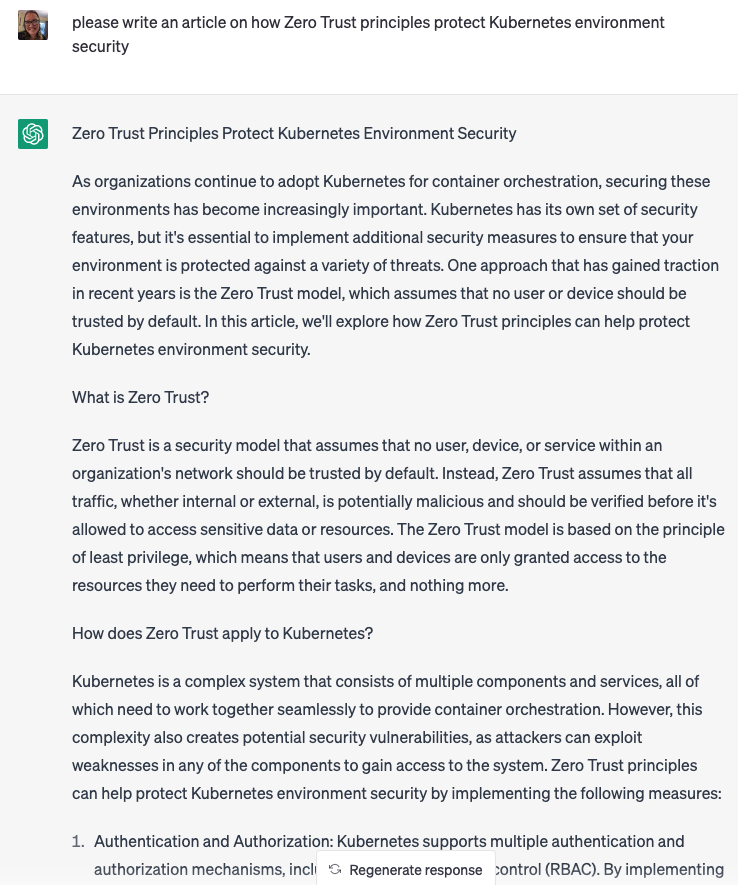
    ChatGPT’s capabilities aren’t quite ready for “please write an article on how Zero Trust principles protect Kubernetes environment security.” At least, not without some editing and supervision, which is what you should do very carefully and thoughtfully if you decide to author complete content with help from the AI language model. 

    Screenshot of ChatGPT's response to a prompt asking for an article on Kubernetes and Zero Trust

    Outsourcing content is nothing new, but outsourcing writing to an AI really is. Like many of you, I have tried in the past using AI directly to write articles, with some interesting and hilarious results. 

    Before ChatGPT, the content was too terrible to use. It was worth a few laughs, but really nothing more. The articles were so funny I shared them around with my writer friends for weeks, then I canceled my subscription, because it wasn’t worth $20 a month. 

    As you can see in the screenshot above, asking ChatGPT for an article on Kubernetes and Zero Trust actually gives a decent result–likely because the internet is awash with Kubernetes content, providing plenty of training material and easy-to-use background information for the AI. 

    Now, this could be the starting point for an article, or could help me understand what questions readers might have about Kubernetes. You could take this draft and interview a SME at your company to add some real meat to the article. I’d avoid publishing as-is. 

    The dangers of using ChatGPT to write 

    Of course, the world of business is full of risks, and marketing is a risky world for business people. Writing on behalf of a brand and speaking for your organization creates business risk, which is compounded by the risks you introduce when you turn to AI for help. 

    Here are a few of the biggest threats to your business: 

    • Inaccuracy
    • Bias 
    • Boring and irrelevant content 

    These are nothing to sniff at, and they should scare you into using generative AI with care, but you can generally prepare for and mitigate these risks. 

    Here’s what you should know. 

    Inaccuracy

    AI is great, but it’s not God. You can’t guarantee right now that anything ChatGPT gives you is 100% true. As a marketer, this should scare you just a little bit. Your brand and your reputation are valuable and difficult to repair once they’re broken. 

    Before you assume anything ChatGPT gives you is true, you should verify it independently.

    Common sense dictates that this is particularly true for situations where information may be relied upon in life-threatening, mission-critical situations. 

    Right now, ChatGPT developers claim the AI language model has limited knowledge after 2021–that’s because of the training data. 

    Considering that limitation, you should be careful using ChatGPT to research bleeding edge, new information and events. The software may not have access to complete information from 2022 and 2023. Anything newer, and you may want to verify that information yourself, especially before you publish it. 

    Bias

    With the AI doing your research and thinking for you, you’re trusting ChatGPT’s model to provide you with unbiased information. The problem with that is humans are biased, by nature. Humans created the internet, which means the data and information available to ChatGPT has inherent biases that may not be eliminated through the software’s programming. 

    Wait, wouldn’t that make biased humans worse and machines better at being objective? Not so fast. 

    We’ve created AI in our image. 

    As the creators of ChatGPT, humanity trained generative AI with what we know, think, love, and hate. 

    If you’ve ever visited one of the internet’s finest cesspools, you know this is a potential drawback for your work. ChatGPT can dredge up the worst of the internet along with the best, and the difference between the two may not always be readily apparent, perhaps especially if the AI presents you with information that confirms popular biases. 

    Think about political issues, discussions around gender, race, sexuality, and big controversies of our time. Fake news is another thing. 

    Machines really aren’t equipped to deal with human issues, even with the best programming. An AI is no replacement for your values and your ability to grasp social conversations. Keep this in mind–it may impact what research, idea generation, and tasks you’re willing to trust AI with, at least for the time being. Humans are better at this right now. 

    Boring and irrelevant content 

    Yes, you can inadvertently create content that’s more boring and irrelevant with AI–which you definitely want to avoid. 

    Relying on ChatGPT to write articles directly without guidance, editing, and appropriate planning runs the very real risk of generating content that’s almost identical to other content on the internet. Instead of creating unique content your audience can use, your writing could lack the creativity and unique contributions necessary to provide enduring value for your readers. 

    Your article could look like 100 others, and not in a good way. 

    How ChatGPT helps with content marketing 

    There are tasks that can be more tedious for human writers. So using generative AI as a writing partner can be helpful, IMHO, if done correctly. 

    Continuously coming up new ideas is tough work, or at least research-intensive work. Online research is also time-consuming. And the actual task of writing those first ideas down on paper sometimes results in writer’s block, even (or especially?) for professional writers. 

    An effective writing assistant could ameliorate some of these issues and make writing more fun and accessible. 

    And for that reason, I’m cautiously optimistic about ChatGPT and content marketing. 

    I hope this helped. (Because I’m human, after all, and if I can’t make the world a better place, I’ll be replaced by a robot eventually.) If it did, please let me know and remember to share it with your friends. Cheers!